written by Jamie Simo

In 2019, the U.S. North American Bird Conservation Initiative Committee released a bombshell report announcing that, since 1970, the U.S. has lost almost 3 billion birds. Last year, its updated report revealed that bird populations are continuing to decline.
Apart from climate change and habitat loss, the number one cause of bird population decline is predation by domestic cats. It’s estimated that cats kill between 1.3 and 4 billion birds each year. Sixty-nine percent of those deaths can be attributed to feral cats, though even pet cats that are allowed to free-roam outside contribute to bird mortality.
Animal welfare organizations such as Alleycat Allies often advocate for “trap-neuter-return” (TNR) as a strategy for humanely managing feral cat populations. However, TNR is not effective in either reducing feral cat numbers or rates of predation.
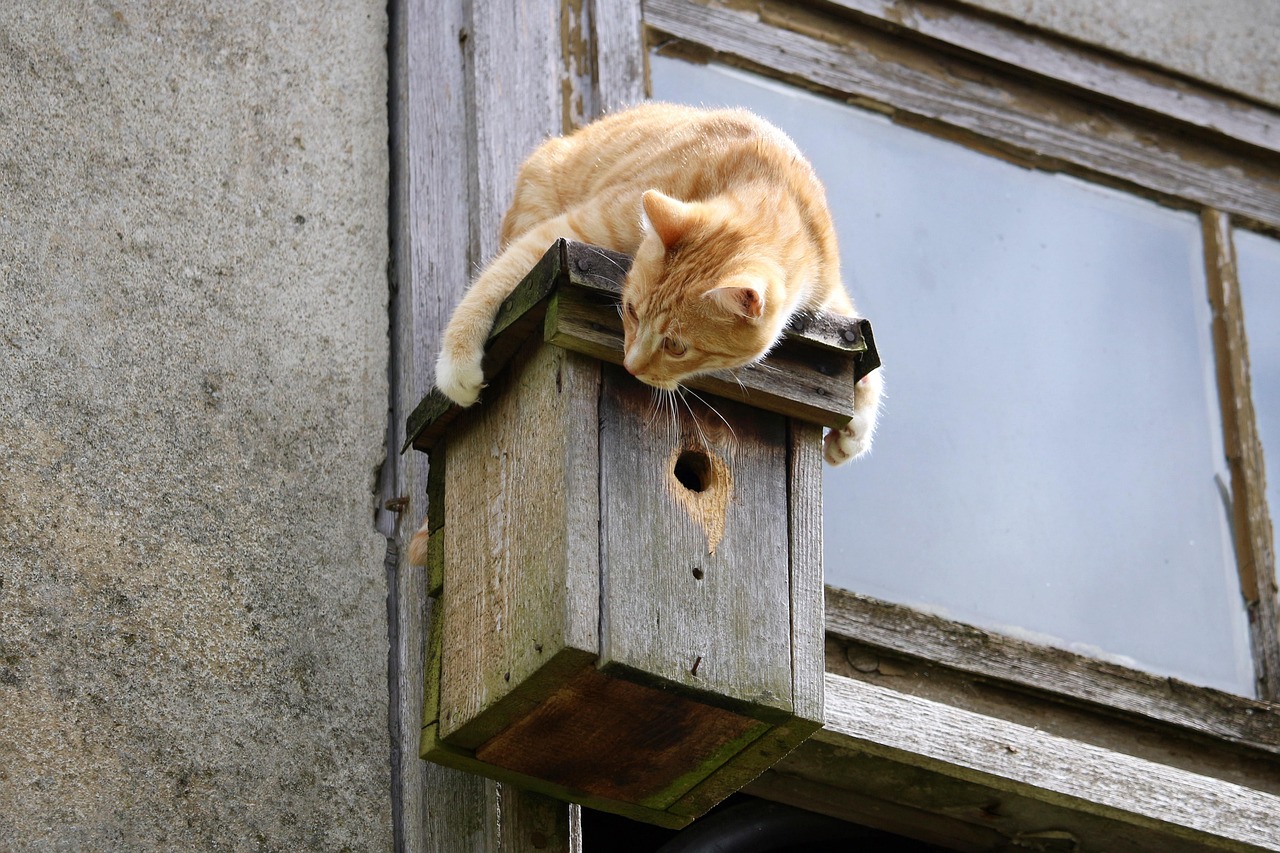
Normally, as prey populations decline, so do predator populations. However, this is not the case with cats receiving supplemental food because even well-fed cats hunt and kill. In addition, when food is abundant, cats won’t defend a territory, leading to high densities of cats in an area and, therefore, to more predation. Feral cat colony numbers are also unlikely to fall when people decide to dump their unwanted pets in the area, trusting that they will be taken care of.
In addition to direct mortality through predation, outdoor cats can be vectors of disease and parasites that can also harm or kill wildlife. Even when a cat merely injures a bird, the bird may still die from a secondary infection due to bacteria that cats carry in their mouths and under their claws. Recently, it has been shown that cats can also carry and pass on the H5N1 avian influenza virus.
Thankfully, there are things the average person can do to cut down on bird mortality from cats and collisions. The best way to prevent harm to wildlife from pet cats is to keep them indoors. Indoor cats are healthier and live longer than cats allowed to free-roam. Building a catio is a great option for those cats that are used to going outside or that get bored easily. Some cats are also able to be leash-trained, just like a dog.
To reduce harm to birds from feral cats, make sure backyard fences are tight with no gaps, including between the bottom of the fence and the ground. You can also install cat-proof fencing, which may include rolling bars at the top of the fence to prevent cats from climbing over. Never feed stray cats to prevent them from being attracted to an area. Because cats are drawn to dry, bare ground for relieving themselves and often repeatedly return to these latrines, cover those areas with rock mulch, chicken wire, or other items that make the area unsuitable for scraping and digging. Natural scent repellants like fox or coyote urine may also help deter cats from an area, as well as installing motion-activated sprinklers.
Just behind cat predation, window collisions are the next most deadly threat to birds. The U.S. Geological Survey Bird-banding Lab estimates that window collisions account for approximately 2 billion bird deaths per year. Birds often don’t recognize windows as solid objects and, seeing the reflection of a tree, bush, or sky, attempt to fly through with deadly consequences. Even when birds fly off after impact, they may still die later from internal bleeding. Artificial lights compound the problem, especially during spring and fall when large numbers of birds are migrating.
Happily, preventing residential window strikes is easy. A number of products are on the market today that are designed to adhere to windows and break up reflections, such as Feather Friendly® or Window GemsTM. If you’re into DIY, you can even apply your own stripes or other patterns using masking tape.
While it’s not as simple as preventing residential window strikes, preventing window collisions more broadly is possible. Citizen advocacy has resulted in some municipalities mandating the use of bird-friendly glass and/or turning lights off during peak migration times. In 2020, Madison, Wisconsin passed Wisconsin’s first bird-safe glass ordinance and in 2021, New York City passed two laws aimed at reducing light pollution. More locally, in 2014, the National Renewable Energy Laboratory (NREL) retrofitted 6,700 square feet of glass at its Golden, Colorado campus to make it bird-friendly following of the discovery of numerous bird strikes. Monitoring 7 years later indicated that bird strikes had been reduced by 98% as a result of that action. Your local Audubon chapter is a great resource to advance laws aimed at protecting birds.
Vehicle collisions are another major contributor to bird mortality. Ground nesting birds or terrestrial birds such as grouse, turkeys, geese, and other waterfowl are particularly vulnerable to being hit because they are slow-moving. Scavenging birds like crows, ravens, magpies, and vultures are also at risk, as are raptors like owls.
To prevent vehicle collisions, pay attention to your surroundings and drive more slowly through areas where wildlife is more likely to live, especially at night or when visibility is low. If you hit a large animal like a deer, contact the proper authorities to have it removed. Often, municipalities have a division that removes large roadkill for public safety. If you hit a smaller animal, consider moving it out of the roadway yourself so that scavengers aren’t attracted to the carcass. Some areas may also have private companies that you can contact to remove roadkill.
Even if it’s biodegradable, never throw litter from a car or near a roadway. Animals, especially rodents like mice and rats, can be attracted to the smell of discarded food. Many raptors trying to pursue prey on or across a road have been hit by cars because their eyes are fixed in their sockets; they are literally unable to see the car coming at them until it’s too late.
Given the news about bird declines, it’s easy to despair, but we can make a difference. Every bird prevented from falling prey to a cat or dying from a window strike or vehicle collision is one more bird that has the opportunity to raise the next generation.
Jamie Simo is a naturalist, graduate of the Denver Audubon Master Birder program, and manager of the Boulder branch of Front Range Birding & Optics.
For more information on what you can do to decrease bird mortality, please see the Protect Our Birds Initiative page on our website.