by Dave Kwasnick

Avian advocates from the National Audubon to the Colorado Front Range’s Environment for the Americas champion leaf litter dominating residential yards. It’s sage advice. As nature intended, doing so unleashes a great many benefits for insects, including allowing young pollinators, such as bees and moths, to mature. (Fun fact: about 70% of the world’s bees live underground.)
As for birds, well, many of those pupae burrowing beneath last year’s fallen foliage are the fat-laden foods than help them survive winter.
But what if you don’t live in deciduously dominated landscapes such as Oak Park, IL, Willow, City, TX or Hickory, NC?
What if you live in Evergreen, CO? Do the needles falling from the Ponderosa Pine, Douglas Fir, Colorado Blue Spruce and other species provide the same benefit?
The answer is yes. But with a decidedly regional twist.
Let’s go back a bit in history: about 320 million years ago. Conifers became the first – and dominant – tree species for several reasons. They conserved water, resisted cold and did very well during temperature fluctuations. (Sound familiar?) Plus their armor-plated seeds (pinecones) allowed for consistent reproduction in harsh conditions.
Deciduous trees came upon the global scene far later – about 125 million years ago – and were welcomed into a decidedly more temperate environment. Their delicate approach to offspring – flowering reproduction – meant they needed fewer volatile conditions to thrive. That’s the reason you don’t see many deciduous trees at high elevation or in far northern climes.
However, the convergence of evolution means that fallen pine needles still provide much the same benefit as fallen leaves to the birds and regions in which they live. Let’s start with soil. Pine needles return several nutrients to the earth, including nitrogen, phosphorus, potassium, calcium, magnesium and sulfur. Basically, it’s everything a subalpine environment needs to thrive. (Just check the ingredients on your regionally correct bag of fertilizer.) They also greatly help suppress weeds, retain critical moisture, and keep soil temperatures regulated for other species to survive.
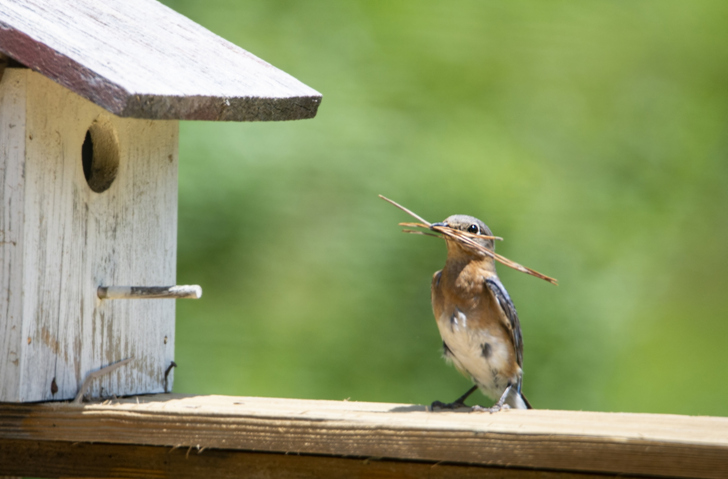
Secondly, downed pine needles (or “pine straw”) also provide a habitat for the larvae of future pollinators and non-pollinators to grow. Both are avian food sources. But it’s hard for birds to survive if they don’t have a home. Once again, that’s where pine needles come on. Those aging bronze needles in your yard act as construction material, allowing many local birds such as Mountain and Western Bluebirds, Tree and Violet-green Swallows, Chipping Sparrows, Pine Warblers, Blue-headed Vireos and Mourning Doves to construct the nests that lead to future generations.
Yet while pine needles are beneficial to so many species, they contain the stuff of wildfires – literally. It’s called turpentine. This resin is both sticky, highly toxic and, for those living in proximity, flammable. Nature bestowed turpentine upon conifers as a way to extinguish their most pervasive predators. Sticky turpentine resin ensnares both insects and fungi, allowing its poison to vanquish both.
Now, in the age of climate-charged wildfires, it can be the stuff of nightmares. Thus, the reason for Jefferson County’s zone-based protocol removing potential ground kindling from around any structure, residential or not. This includes all fallen pine needles from zero to thirty feet of any building. It makes sense. And while it may seem a bit draconian for birds and other wildlife, consider this: the land around Evergreen includes tens of thousands of acres under the auspice of Jefferson County Open Space and the U.S. Forest Service. Here, properly managed and far away from buildings, pine needles are free to fall where they may.
Just as nature intended.
Dave Kwasnick
Dave Kwasnick, is an avid birder, writer, nature photographer and, along with his wife Lori, owner of Front Range Birding & Optics in Littleton and Boulder, CO.